Tuesday, October 26, 2010

Locomotion: Jacqueline Woodson


 Locomotion is written by author Jacqueline Woodson. This novel is aimed at students who are in middle school, grades 6-8. Woodson tends to focus on a lot of family related issues within an urban setting where black students are the main characters or there is an interracial mix. Her work could be seen as controversial since it deals with different issues such as death and suffering, which some feel students should not be exposed to within schools. I personally believe her writing is fantastic and controversy should not over shadow what she has to offer as great literacy to sink into within a classroom.
Rating: 4.5 out of 5 Stars
Summary: Lonnie is a nine-year-old boy who has lost his parents in a house fire. Separated from his younger sister and in foster care, Lonnie searches to fit in and come to terms with the tragedy that has stricken his family. This book captures the thoughts and feelings from Lonnie’s perspective through poetry. This novel is sectioned out into many different kinds of poems, short and long, that really give the reader and insight not only to Lonnie’s feelings but also exposing them to the genre of poetry and ways it can be used.
I really enjoyed reading this book. At first, I was a little skeptical because I am not a fan of poetry. I was proven wrong as the poetry beautifully depicts what Lonnie is going though. There is a lot of sadness in this book. Lonnie is constantly struggling to understand and come to terms with the loss of his parents while he is separated from his sister. A major theme of this book is acceptance. Lonnie wants to be accepted at school, within his foster home, by his sister’s foster parents, and also he personally needs to start to accept his situation and the death. Religion is also strongly referenced. Ms. Edna his caregiver is constantly praying and talking to God and Lonnie’s sister Lili also tells him that he needs to find God and gives him a Bible. Religion is a touchy subject within schools so I think it is important for teachers be careful when they go about focusing on this topic within the book.
Since Lonnie is experiencing a lot of different emotions and sometimes people can use writing as an outlet. This book is a great example how poetry can be used as an escape and a way to get feelings out. This is a good message to convey to students. Poetry and writing is not just factual or for a academic purpose, writing can be an outlet and way to express something that cannot be said aloud or understood. This also can be used to expose students to different types of poetry and Locomotion would be a great book to include within a poetry unit. Poems such as haiku’s and free verse are included along with many more. The writing is descriptive and precise that they would serve as wonderful examples.
Finally, this book also provides a different perspective. It is told from the viewpoint of an African American boy. In children’s or young adult literature, it is not as common to have a viewpoint from a minority group.  I think it is great way to include diversity and get students to understand how and what the world is like through someone else’s eyes. Some of the language is even written how a nine-year-old boy would spell and even pronounce certain words.
Overall this is a quick, easy read but sends a powerful message. It is also a little outside the box in that it is a entire novel of poems but it still is just as meaningful as a personal narrative or a typically written novel. This is a great book to change up the reading selection and give students a different taste from many different standpoints. 

Jacqueline Woodson is an award winning author and has been recognized for her outstanding work. Get information on Woodson herself, other books, and the sequel to Locomotion; Peace, Locomtion here.

The Giver


The Giver is written by Lois Lowry and is the winner of the John Newberry Medal. The Giver is a highly controversial science fiction novel, but is a great literary piece of be taught in the classroom.
Rating: 5 out of 5 Stars *****
Lois Lowry
Summary: Jonas lives in an artificial world where choices are limited and the citizens always follow the rules. It is a society that does not encourage diversity. There is one track, and everyone follows it, sheltering people from life’s real issues and the pain or happiness that can be felt along with it. There are no color or opportunities to go outside of what is deemed as “normal”. When Jonas meets The Giver his whole world is changed since he has the insight to a world of limitless feelings, experiences, and ideas.
The Giver is a fantastic book to teach in a classroom. This should be a book that is taught in an older middle school classroom (seventh or eighth grade). There are a lot of heavy issues such a pain, suffering, and death that can be graphic and descriptive. There is also a lot of depth to this story so students need to be at an appropriate level to think more outside the box and understand the different aspects that are incorporated into the text. This book uses very vivid imagery and descriptions to create depth and complexity. Lowry does a fantastic job at creating this artificial world that is so much different from the world that we live in today. 

I never had the experience to read The Giver when I was in school but I am glad I have had the experience to read it. It has a lot of major themes such as power, choice, pain, fear, and lack of diversity. These are all themes that students can relate to and discuss. This book can be great to parallel our society and compare and contrast the differences. How would our society be if it were similar to the society in The Giver? How would the society in the book be different it people were allow to speak about their feelings and be able to show pain and suffering? There are so many different aspects this book can take on and lead to great discussions.
I personally cannot imagine living in a society where there are no choices or variety. I think this book really speaks to students in that they should value and embrace diversity and be able to appreciate the fact that they do have the freedom to do pretty much whatever they want. Even though The Giver has a fictional plot and society, there are places in the world where freedom and diversity is limited. It is important ideas to pass down to students who may be more sheltered and less understand about the power of freedom and choice.
This book takes on a lot of typical characteristics of science fiction. It revolves around a future, artificial world and other elements such as a strong plot, well-developed characters, and themes. The plot is something that kept me intrigued with this book. I was constantly worrying about what was going to happen and what Jonas was going to do next. I think a really important element to plot is making readers want more and to continue on reading. One thing that is frustrating about this book though is the ending. It really leaves you hanging and unsure of what exactly happened to Jonas. At the same time, maybe this is just another reason why this book is so brilliant. It leaves lingering questions opened to interpretation that can spark amazing class discussions.

How Do Dinosaurs Say Good Night?


How Do Dinosaurs Say Good Night? is written and illustrated by Jane Yolen and Mark Teague. This target audience for this picture book is kindergarten and first grade boys and girls. Author Jane Yolen is an award winning writer and illustrator Mark Teague has received much recognition for his beautiful illustrations.
Rating: 4 out of 5 Stars ****
Summary: This picture book references ten different dinosaurs and the possible situations that could arise when trying to put them to bed!
This is a wonderful picture book to have available in the classroom for new and beginning readers for an independent read or for a read class read aloud. There are so many directions the book can go.
This book is great for a beginning reader because the language is simple and patterned. There is a lot of repetition that occurs that help give the reader a sense of predictability and familiarity. Repetition is key factor in learning to read. The rhythm and rhyme scheme of the text also helps young readers as well (Fox, 1988).
This book can also be used as a read aloud. The text and illustrations are large enough for students to see while the teacher is reading. The illustrations also incorporate a lot of humor that would be great for drawing in readers. The dinosaurs and other aspects of the illustrations accurately depict what the text says. If How Do Dinosaurs Say Goodnight? is being read aloud, specific subjects can also be referenced. In kindergarten a lot of students start to develop and learn about routine. This book deals a lot with what proper bedtime behavior and routines consist of and can easily be taught to students. Not only do students get a visual representation of behavior, the story can also make way to a discussion of what proper bedtime behavior is and what types of things students do before they go to bed. Teachers and students can design charts of webs about appropriate behaviors and rituals.

Another angle this can be looked at is through science. Dinosaurs are a unit that most children enjoy in elementary school and books can be a great resource to learn about them. This book specific touches on ten different types of dinosaurs. Each name of the dinosaur is incorporated into the illustrations and they are also clearly represented physically through detailed pictures. Using this book to talk about dinosaurs seems to be a more appropriate unit for a first grade classroom.
As a small side note, this book does a great job showing diversity. Different mom’s and dad’s are shown throughout the illustrations representing different cultures of people. This can help a book speak to students more when they can identify with people who are similar to them and share the same qualities.
Jane Yolen
Jane Yolen has written a whole series of books based off of dinosaurs such as How Do Dinosaurs Eat Food?, How Do Dinosaurs Clean Their Room?,  and many other topics. Visit her website: http://janeyolen.com/

The Man Who Walked Between The Towers


The Man Who Walked Between The Towers is written and illustrated by Mordicai Gerstein. It is the winner of the Caldecott Medal for it’s outstanding illustrations. The target audience of this picture book is aimed at first through fourth grade students.
Rating: 4 out of 5 Stars ****
Summary: This is the true story of Philippe Petit who walked a tight rope between the World Trade Centers in New York City, August 7, 1974. The author speaks about the great feat of the trick and how the memory of the stunt will live on forever just as memories of the World Trade Centers will as well.
One great thing about this book is that it is a true story and not very often do we find teachers using nonfictional, true events within the reading curriculum of the class. Explaining to students that this is a true story can be a great way to draw them into the reading and give them a different type of experience through a picture book. The pictures themselves can tell the story alone but the text is also written beautifully. It is not too wordy for young children but not too simple for an older audience, not to mention the text compliments the illustrations well. I think that children would be intrigued by this story from the standpoint of that this an almost unimaginable trick that fascinates the mind.
Read about the real Philippe Petit here: http://longliveirony.com/Petit.html
Watch a pictorial of photographs from the historical day: http://www.youtube.com/watch?v=6ddpV1GvF7E
 I feel this book can be used in two different ways within a classroom. First, teachers can design great lessons surrounding the physics that went into this extreme act. It takes a lot of understanding of the laws of physics to pull off what Petit did. Discussions can be formulated around ideas such as balance, gravity, and mass. The second way this book can be incorporated into a classroom is to talk about the history of the World Trade Centers and the events that book place before September 11, 2001. This can be linked to history as students can be exposed to the history that led up to their destruction on that fatal Tuesday morning. Young children in school now are either too young to remember 9/11 or were not even alive to experience what that day was like. It is an important part of our countries recent history and will never be forgotten. Students should be exposed to the WTC and their meaning should be explained within our history. The book does not reference the terrorist acts, the author only briefly acknowledged the towers are now gone. Students may be wondering what happened to them and leaving hanging questions that should be answered since it is a significant event.
Philippe Petit

Leonardo the Terrible Monster


Leonardo the Terrible Monster is written and illustrated by popular children’s book author Mo Willems. This book is targeted at kindergarten and first grade students. The humor incorporated into the text and the silliness within the illustrations will capture the hearts of young readers.
Rating: 5 out of 5 Stars *****
Summary: Leonardo is not a very scary monster but longs to be just as scary as his fellow monsters. He sets out to find a suitable suspect to scare but instead of wanting to be scary he just wants to be a good friend to a little lonely boy Sam.
The two major themes of this book, friendship and acceptance, are great ideas to discuss within a younger classroom such as kindergarten and first grade. This book tells the simple story of what it means to be a friend and how to go about accepting people who may seem to be an outcast. Kindergarten and first grade are the first years where students come together in a setting to start to form friendships. It is important to enforce the ideas behind friendship at an early age so students are properly exposed to what it means to have a friendship and accepting others. This heartwarming tale is classroom must have!
This book can easily fit into a unit about friendship and can further lead into classroom discussions about what I means to be a good friend through charts or lists. It can also be geared in another direction such as conflict resolution and how to manage problems within a circle of friends.
Visit Mo Willems Website to see more hilarious and useful books for the classroom. Willems makes it easy to incorporate a sense of humor into the classroom with still making it possible to connect to an important concept. Click Here!

Sunday, October 24, 2010

Hunwick's Egg


Well-known and respected children’s book author Mem Fox writes the creative story of Hunwick’s Egg, illustrated by Pamela Lofts. The target audience of this book is first through third grade students. Students will enjoy reading and seeing the illustrations based off of Australian wildlife.
Rating: 4/5 out of 5 Stars
Summary: Hunwick is a bandicoot, native to Australia, and he finds a mysterious egg one day after a storm. The egg did not have a home to Hunwick decides to take care for the lost egg and befriend it. Time goes by and the egg does not hatch. The other animals begin to worry if it will ever hatch and have their doubts. But, Hunwick is not worried about the egg hatching and chooses to love and cherish it just the way it is.
Hunwick’s Egg is a classic tale of friendship and companionship. Mem Fox is an incredible children’s book author who does not disappoint in this story. The story takes in the idea of friendship through diverse wildlife that children’s books do not usually incorporate such as a bandicoot, an emu, and a cockatoo. Most young readers are most likely unfamiliar with such animals and it is great exposure to different type of animals than typical animals found in the United States. The illustrations are extremely detailed and give readers a visual representation of the Australian wildlife represented. Not only will the pictures draw a reader in but also the suspense of whether or not the egg will hatch or what will come of the friendship between the egg and Hunwick keeps the reader guessing and predicting what will come next.
This book has a lot of great elements for young or new readers. It can be used for a read aloud in the classroom or can be an independent read. The repetition of the text helps give readers a sense of familiarity and comfort as they read along. The illustrations also provide contextual clues for readers if they ever find themselves struggling with a page or series of words. Students can also relate to the text in what it is like to make a friend and dealing with what other people’s opinions are. The overall vocabulary is not complex though students might have a hard time understand the animals in the story if they have not been exposed to such animals before. A pre-reading activity to build schema about Australian wildlife and animals may be appropriate before reading this book.
I would use this book in my future classroom. I believe it sends a great message about friendship and what it means to have a caring and nurturing friendship. I would use this book for a read aloud and have it available for an independent read within a classroom library. It can tie into a unit on friendship but also it can be used to explore different ecosystems such as the Australian desert.

Side note about author Mem Fox: She is a world-renowned literacy specialist and educator. She has written many children’s books but also book on how to teach literacy. Fox travels around the world giving presentations and speaking about children’s literacy and other related issues (Wikipedia). Visit her website at: http://www.memfox.net/welcome.html to view other books, hear her read aloud, and find out more information on children's literature. She has also been recognized with several awards for her writing and work within the children's literacy field.

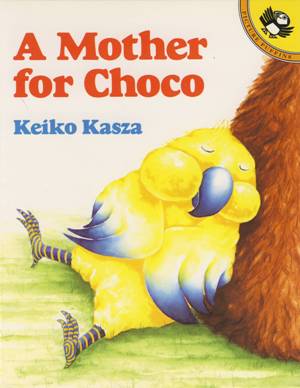
A Mother for Choco


A Mother for Choco is written and illustrated by Keiko Kasza. The target audience of this book is preschool and kindergarten aged students. Both boys and girls would enjoy this heartwarming tale about a small bird searching for his mother.
Rating: 5 out of 5 Stars *****
Summary: Choco is a small yellow bird that is upset because he does not have a mother to take care of him. He sets out of find his mother by asking different animals if they are his mother. Choco becomes discouraged when he cannot find anyone until Mrs. Bear finds him upset in an apple orchard. She brings him home to join her and her other children, who happen to be different as well. Mrs. Bear’s family is made up of her, a pig, an alligator, a hippo, and the newest addition Choco the bird.
I found this book to be fantastic and tackles the complex idea of adoption/foster care. This can be a hard idea to explain to young children or students and a book is sometimes an easy way to make a point with young readers. Adoption and foster care is a common situation for children to be in and it is important to know that families can be made up of people of different races, cultures, and backgrounds. A family does not have to be made up of a mom and a dad and their children they gave birth to. Family can mean many different things and A Mother for Choco is a great example on how to explain the idea of differing families. 

I would use this book in a preschool or kindergarten classroom within a unit on family. Not only is this a great story, the illustrations also accurately depict the storyline with vibrant colors and detail, which can be appealing to readers. This would be a prefect read aloud book that could lead into a discussion on different types of family and the ideas behind adoption and foster care. It is important to expose children to different situations families can be apart of. Students in a class could possibly be in a situation and could elaborate on how they feel and what the experience is like for them. The book uses animals that are kid friendly and appealing to younger readers. This also doubles as an example of different types of races and people. The animals are all differing like how people differ within the human race and even in families.
Below is a video link to A Mother for Choco being read aloud: 
Visit author Keiko Kasza's website to see other children's books and information.